Projects & Legacy
Launching our Cobham Schools Heritage Pilot
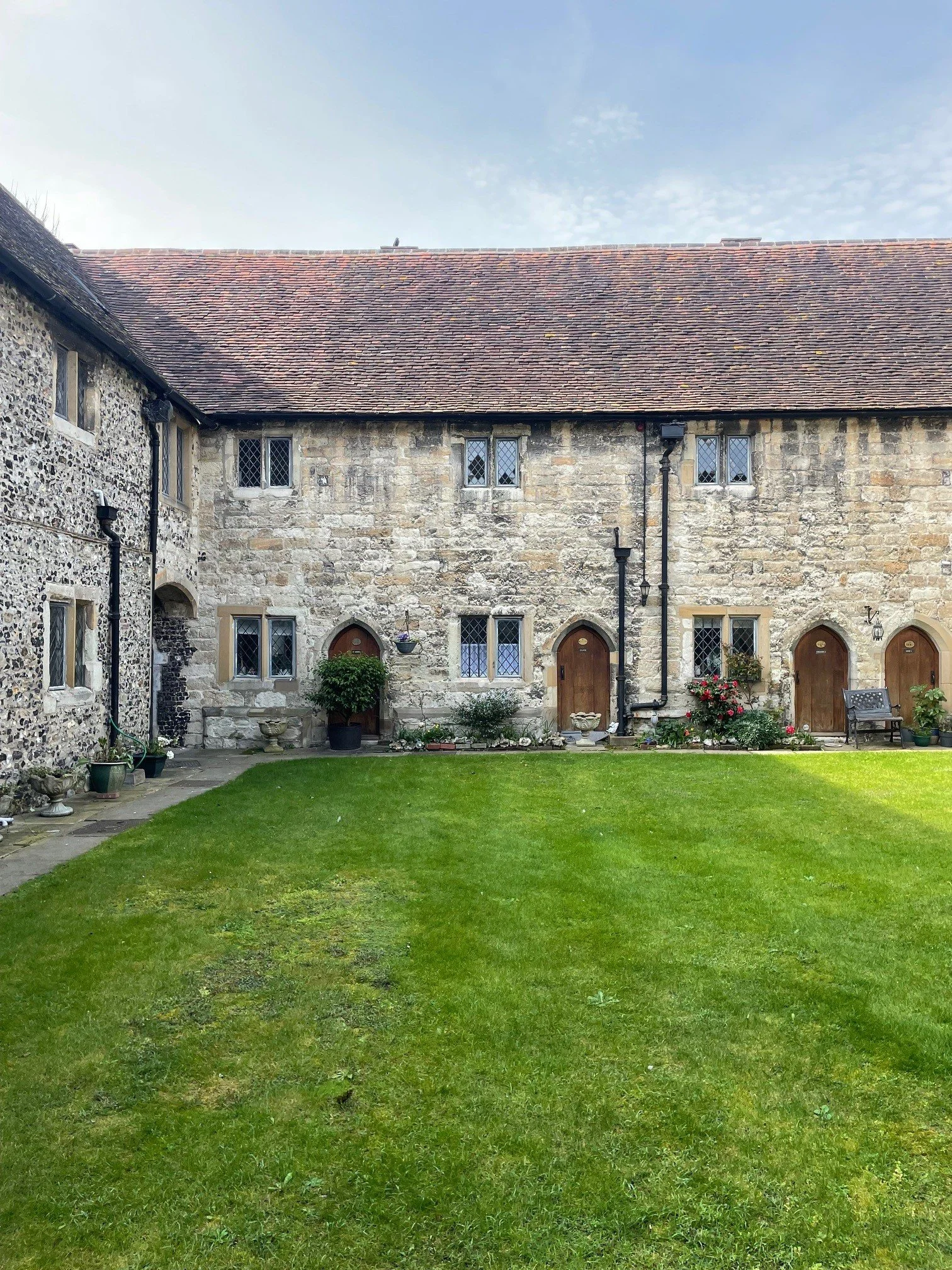
New College of Cobham HBHT 2025
We are delighted that the Herbert Baker Heritage Trust CIC will be delivering a new heritage pilot with Cobham Primary School, supported by a grant from National Highways Lower Thames Crossing delivered through Kent Community Foundation.
This small but important project will help pupils explore the heritage on their doorstep — from Owletts (National Trust) to St Mary Magdaelene Church, Cobham and the historic New College of Cobham.
The visits will engage children in the stories, buildings and landscapes that make Cobham such a special place. A digital learning resource will be created and shared online for all.
Our 2026 Heritage Craft Skills Training Week
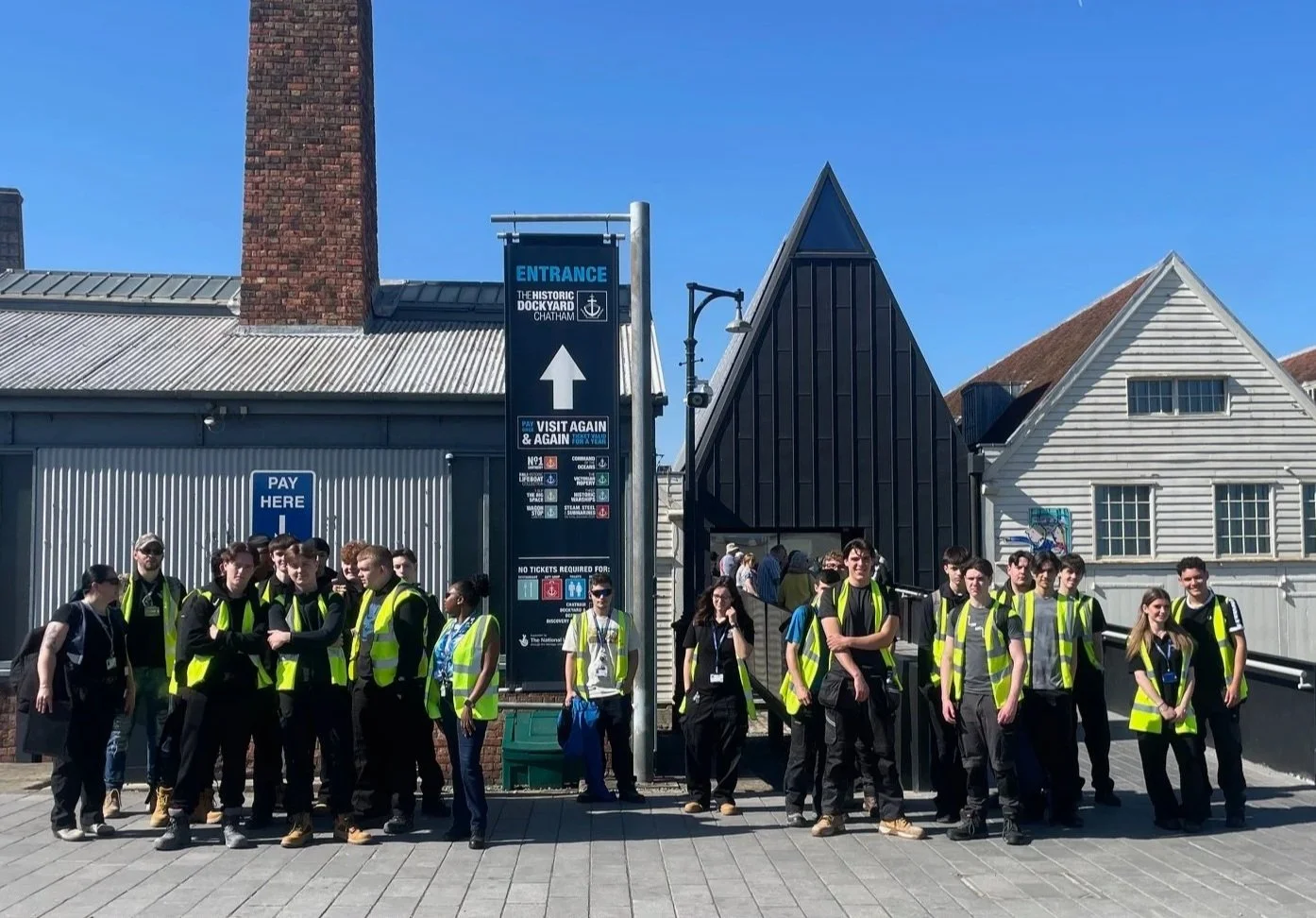
Students at Chatham Historic Dockyard
In April 2026, the Herbert Baker Heritage Trust delivered its inaugural Heritage Craft Skills Training Week, offering students from Kent an introduction to the conservation of historic buildings and traditional craft skills. Over five days, 95 participants visited some of the county’s most significant heritage sites, meeting the professionals responsible for their care and gaining valuable hands-on experience in a range of heritage crafts skills.
At Canterbury Cathedral, the team at the Stonemasons’ Yard led the first day of training. Students were given the rare opportunity to visit the drawing office, meet the estates team and explore the Bastion Chapel (which Baker restored in the 1920s). This was followed by a visit up on to the Corona Tower roof, and a practical stone masonry workshop where they got hands on with the materials.


Hands-on workshops at Canterbury Cathedral Stonemasons’ Yard
On the second day, students travelled to Rochester Bridge and Rochester Cathedral to explore historic building materials, civil engineering and conservation practice. Sessions focused on the challenges of maintaining and preserving important historic structures while balancing modern day use and ideas around sustainability.
Day three took place at the Building Crafts College, one of the UK’s leading providers of specialist construction craft education. Students learned more about training opportunities in traditional building crafts and discussed apprenticeships and career pathways. The chance to speak to current students and recent graduates made these opportunities very real and clear to the participants.

Traditional stool making at the Furniture Craft School, Scotney Castle Estate
The fourth day was hosted by the Furniture Craft School in the grounds of Scotney Castle. Students spent the day in the workshop learning traditional furniture-making techniques, using unfamiliar tools and creating a traditional milking stool which they were able to take home.
The training week concluded with a visit to The Historic Dockyard Chatham. Students met heritage professionals responsible for the care of the site’s many listed buildings, and gained practical experience in the historic ropery. They were toured around the recent restoration work on Commissioners House by the expert in charge, and discussed first hand the reality of heritage career opportunities.
The week provided students with an inspiring introduction to heritage conservation and traditional craft skills, in particular highlighting the ways in to the sector and the wide range of heritage career opportunities available.
Sir Herbert Baker’s archives at RIBA Collections

During the 1980s and 90s, Michael Baker donated drawings, photographs and paper based archives from the office of his grandfather, Sir Herbert Baker, to RIBA. The collection included thousands of items, not only documenting the commissions that Baker’s architectural office completed but also collaborations with artists, craftsmen, building professionals and patrons, alike. In 2022, Baker’s personal papers joined the collection, through a further family donation, and are now accessible to the public.
In 2025, RIBA Collections kindly agreed to share 168 digital copies of Baker’s photographic collection, now in their ownership, with the Herbert Baker Heritage Trust. The HBHT are delighted to be able to use images from the collection, that document so many of Baker’s iconic, and lesser known, commissions and help encourage access to this rich archive.
Our thanks go to the team at RIBA for their support.



Image Credits - RIBA Collections. RIBA gratefully acknowledges the donation of the Sir Herbert Baker archive by the Baker family.
Inspiring future makers
Our 2025 Heritage Skills Pilot programme was a great success. We invited students from Medway to explore local heritage sites and try their hand at traditional crafts — from timber frame woodwork to stone masonry.
It was wonderful to offer this hands-on experience and inspire students by giving them an insight into the world of skilled heritage trades.
We’re incredibly grateful for the ongoing support of our partners: Rochester Cathedral, Canterbury Cathedral, Medway Council, and Mid Kent and North Kent Colleges.
Watch our short film to see the programme in action
New research in to Baker’s building conservation legacy
In September 2025 postgraduate researcher Tatum Goins began the first PhD dedicated to exploring Sir Herbert Baker’s building conservation legacy. The Collaborative Doctorate Award, based at University of York and funded by the White Rose College of the Arts & Humanities, will examine some of Baker’s lesser-known conservation projects. The research will consider how Baker approached the challenge of safeguarding historic buildings for future generations.
By assessing these buildings nearly a century on, Tatum’s research will offer new insight into Baker’s long-term impact on conservation practice and the relevance of his methods today.

-
Hello all! My name is Tatum Goins, a WRoCAH (AHRC) funded Conservation Studies PhD researcher at the University of York. I’m from South Carolina in the USA. With my family living close to the historic city of Charleston, I grew up with a fascination and passion for historic buildings. Some of my fondest, earliest memories are of taking tours of old homes in the sweltering, summer heat of the South Carolina low country. I carried that passion with me through university, where I gained an undergraduate degree in history. Nearing graduation, one of my professors recommended I look at the University of York for pursuing a postgraduate degree. I applied and was accepted into the Conservation of Historic Buildings programme, where I gained theoretical and practical experience in the field of buildings conservation. As I was working on my dissertation and planning my next steps, I heard of a funded CDA in partnership between the University of York and the HBHT. The research was to be focused on Sir Herbert Baker’s conservation legacy. I swiftly read John Stewart’s recent biography of Baker and decided to apply.[1] I was delighted to be given the opportunity to work on this research, and now, almost a year into my work, I have formulated my research design, made good progress on a literature review and have begun to formalise my methodology.
Herbert Baker’s architectural and conservation legacy have been contested by critics, none more haunting than Sir Nikolaus Pevsner, who in his 1957 London I portion of his Buildings of England series claimed that Baker’s Bank of England was ‘the greatest architectural crime, in the City of London, of the 20th century’.[2] Although the greater portion of Baker’s bank was a rebuild as requested by his commissioners, Pevnser’s words have served as a definition of his conservation legacy. But times and opinions change. My research will reevaluate Baker’s conservation legacy through a contemporary lens. By analysing multiple case studies from Baker’s conservation work using an interdisciplinary approach, we can better understand and evaluate his conservation legacy. My methodology utilises aspects from the fields of architectural history and archaeology, using both documentary evidence and buildings recording techniques to form a comprehensive and balanced analysis of Baker’s conservation work. While the Bank of England work serves as important context, my research analyses a wider selection of conservation work undertaken by Baker. My case studies span Baker’s entire career: the Bridge Chapel in Rochester, Yeoman’s House in Cobham, Bastion Chapel in Canterbury and Summer House in Cape Town. Through my research, I aim to show that Baker’s work on historic buildings speaks louder than the now historic words of a single critic. I hope this will contribute to a proper analysis of Baker’s conservation reputation and legacy.
References:
[1] John Stewart, Sir Herbert Baker: Architect to the British Empire. (Jefferson, North Carolina: McFarland, 2021).
2 Nikolaus Pevsner, London I: the cities of London and Westminster. (Harmondsworth, United Kingdom: Penguin Books, 1957).
Tatum Goins researching Baker’s drawings at the RIBA collection
with Fiona Orsini, Curator, Drawings and Archives Collections
A shared commitment to heritage craft skills

Canterbury Cathedral
The Cathedral Workshop Fellowship - a partnership of fourteen Anglican cathedrals - has become the Trust’s asset lock, ensuring that our long-term charitable objectives remain protected. Both organisations are dedicated to sustaining traditional heritage craft skills through training opportunities and practical experience.
Sir Herbert Baker’s passion for preserving Britain’s rich ecclesiastical heritage makes the Fellowship a natural partner for the Trust. Together, we look forward to developing shared projects and expanding training opportunities that will support the next generation of skilled craftspeople.
Baker's Commonwealth War Graves Commission Legacy
In September 2025 the Commonwealth War Graves Commission and the Herbert Baker Heritage Trust launched a partnership to explore Sir Herbert Baker’s lasting contribution to the former Imperial War Graves Commission, where he served as one of three Principal Architects.
Baker worked on 112 war cemeteries and memorials, helping to shape the Commission’s enduring architectural style of dignity and remembrance. He is perhaps best known for the Tyne Cot Cemetery and the Indian Memorial to the Missing at Neuve-Chapelle, which remain among the CWGC’s most visited and powerful places of commemoration.

Tyne Cot Cemetery, Belgium, designed by Herbert Baker, 1927
Champion of Arts and Crafts
Sir Herbert Baker:
In February 2025 our founder, Camilla Baker, was invited to speak at Downing College, Cambridge, as part of a seminar series hosted by the Centre for the Study of Classical Architecture .
Camilla delivered an engaging overview of Baker’s prolific career, reflecting on the remarkable breadth and variety of buildings he designed throughout his 50 years in practice. She shared personal insights into her early education in architecture, shaped by growing up at Owletts, the Baker’s family home in Kent, which in 1937 was bequeathed to the National Trust.
We are very grateful to the CSCA for their kind invitation and for hosting such a thoughtful and stimulating series.
Watch a talk about Herbert Baker’s legacy
Honouring Baker’s legacy
Sir Herbert Baker was not only a visionary architect, he was a passionate champion of craftsmanship. He believed in the importance of passing on skills to future generations, and saw the value in preserving history while giving it new purpose.
At the Herbert Baker Heritage Trust we honour this ethos by exploring the rich legacy of Baker and his collaborators, and by supporting initiatives that nurture creativity, craft, and heritage today.

Union Buildings, Pretoria, South Africa, H. Baker;
watercolour H.L.G. Pilkington, 1909
Make a donation
Help us inspire future makers to learn and value heritage craft skills. Your contribution supports education, advocacy and hands-on training that keeps craft and traditional building techniques alive.

‘I learned more history today than I ever did at school’
Student
With thanks to our supporters